Interview by Trine Bastian, Head of Communications, AJ Vaccines
Blessina (“Blessi”) Kumar is CEO of the Global Coalition of TB Advocates (GCTA). For nearly two decades, she has championed a people-centred, rights-based approach to tuberculosis (TB), focusing on ensuring that people affected by TB are included in decisions that shape policies and programmes.
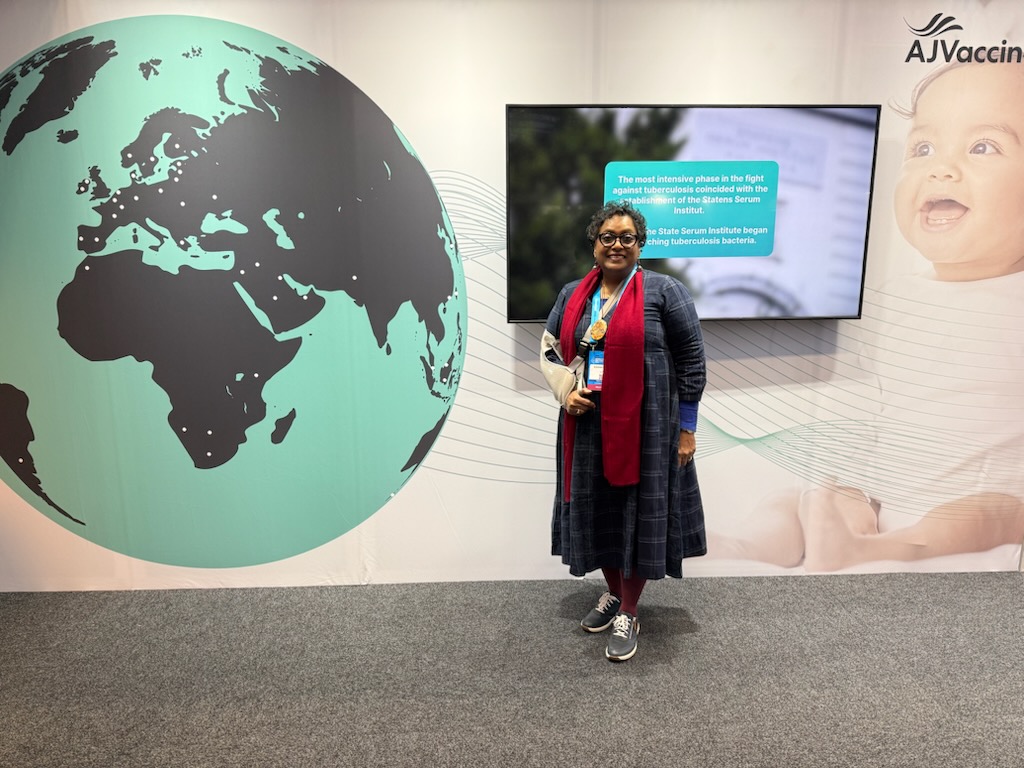
We spoke with Blessi during the Union World Conference on Lung Health 2025 in Copenhagen about why equity remains a critical challenge in Tuberculosis (TB), and what it takes to build responses that work in real life.
Blessi, you opened our conversation by saying: “There is no equity in TB.” What do you mean by that?
Blessina Kumar:
When I say there is no equity in TB, I am describing what many TB-affected communities face every day. TB disproportionately impacts people who already experience other disadvantages, including poverty, overcrowded housing, insecure employment, and limited access to healthcare. At the same time, those most affected are often the least heard when TB policies are developed. Consequently, the people with the highest disease burden hold the least power to influence the response. That is what I mean by inequity.
You’ve said we can’t talk about equity in TB without also looking at gender. Why?
Blessina Kumar:
For me, gender is a crucial aspect of the equity discussion in TB. Globally, more men than women are diagnosed with TB. However, in many contexts, women may encounter a greater social and economic burden when they fall ill. Some may need permission from a spouse or family member to seek treatment. Others may fear stigma — being blamed, ostracised, or regarded as ‘unfit’ for family roles.
That fear can lead to delayed diagnosis, interrupted treatment, and long-term consequences — not only for women, but also for children and households who depend on them”.
And when resources are limited, community-based organisations, many led by women, can be among the first to feel the impact, even though they are often closest to local realities and trusted by the communities they serve. If we don’t consider a gender perspective where it is relevant, we risk overlooking who is being left behind and why.
What factors can lead to women and children being overlooked in TB efforts?
Blessina Kumar:
“It’s often a combination of social norms and how services are structured.
In some settings, women may have less control over movement, finances, or time, which can make it harder to seek care. Social expectations and caregiving responsibilities can also lead women to delay their own care.
Stigma remains one of the most significant barriers. Some women may fear blame, social isolation, or adverse consequences at home or in the community, which can affect timely diagnosis and treatment adherence.
For children, the impact is often indirect — through disrupted schooling, instability at home, or reduced access to supportive care when caregivers are ill or stigmatised.
Addressing these barriers typically requires more than technical solutions. It can include gender-sensitive training for health workers, sustained support for trusted community partners, and deliberate efforts to ensure women’s perspectives are represented in TB governance and decision-making. When resources are constrained, protecting these elements can be essential for long-term effectiveness.”
You often talk about a rights-based, people-centred TB response. What does that look like in practice?
Blessina Kumar:
“Access to treatment remains a significant issue in many regions because services are not always aligned with people’s daily realities. Clinics can be located far away. Opening hours may be too rigid. Procedures can be complicated. The underlying message becomes: people have to adapt to the programme, instead of the programme adapting to people.
A people-centred, rights-based response means asking whether women, children, and underserved groups are meaningfully included in the design, evaluation, and delivery of TB services and solutions. It means involving communities early, valuing their time and expertise, and recognising them as partners.
In practical terms, that can look like community advisory boards, and support for trusted local organisations, and services that go to where people are, and not only centralised facilities in major cities.”
What role can communities play in TB research and programmes?
Blessina Kumar:
“Community engagement should not be treated as an afterthought or a communications add-on at the end of a project. It should be built into how research questions, programme design, and policy are shaped from the beginning.
Affected communities bring insight that data alone cannot provide. They can help identify who is being missed, what barriers people face, which messages resonate — and which messengers are trusted.
For engagement to be meaningful, the relationship needs to be genuine and balanced. Communities should not be involved solely as a channel for information sharing. That means creating space for open input, recognising the contribution and effort involved, and ensuring community representatives have real opportunities to help inform decisions.”
You describe TB as a profound injustice. What needs to change?
Blessina Kumar:
“Each year, more than a million people die from a disease that is both preventable and curable. That is a sign that TB still does not have the political priority it deserves.
Changing this requires shared responsibility. Communities cannot carry the burden alone. Governments, international organisations, companies, researchers, and civil society all have roles to play.
Public leaders can help reduce stigma and support sustained investment. Researchers, manufacturers, and programme designers need to ensure affected communities are at the table when decisions are made about vaccines, diagnostics, and treatment.
No one is ‘doing communities a favour’ by involving them. If we want to end TB, we have to act — and work — as true partners.”
Why voices like Blessina’s matter
For AJ Vaccines, perspectives like Blessina Kumar’s reinforce that equity and community engagement work best when they are integrated from the beginning — in how programmes are designed, how partnerships are built, and how trust is strengthened over time.
Blessi´s perspective also highlights that TB efforts are less effective when they miss who is being reached, whose voices are absent, and how social conditions influence access to diagnosis and treatment.
By bringing these insights forward, voices like Blessina’s help move the global TB response from intention to impact — towards a future where circumstances beyond a person’s control do not determine access to prevention, diagnosis, and care.
This interview was conducted at the Union World Conference on Lung Health 2025 in Copenhagen as part of our “Voices in the Fight Against Tuberculosis” series, highlighting perspectives from advocates and experts working every day to end TB.